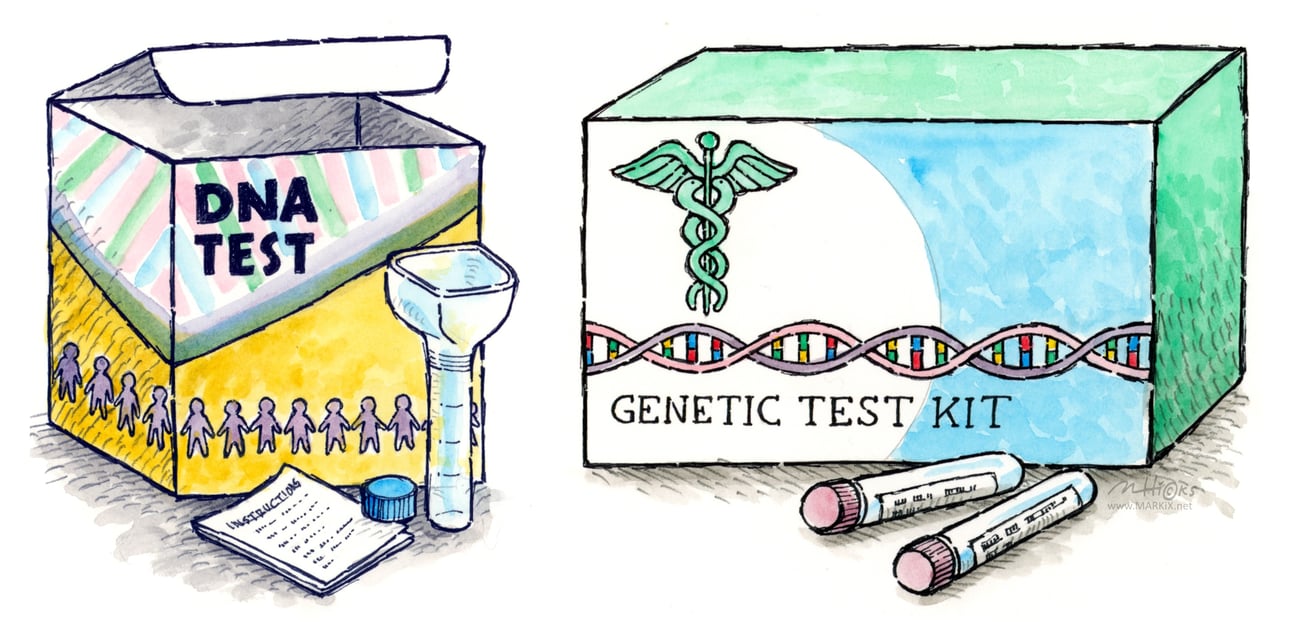
Genetic testing has never been more widespread or accessible. People who want to learn about their genes have their pick of tests from laboratories and online companies. ConnectMyVariant members use medical tests ordered by doctors as well as commercial tests purchased from companies like Ancestry, 23andMe and MyHeritage. Medical and commercial tests may seem similar because they both examine blood or saliva to analyze its DNA. However, these types of tests play different roles in tracing inherited disease through families.
Medical and commercial tests look at different parts of DNA.
DNA is made of building blocks that lock together into long strands. Most human DNA has no known purpose, but some parts of DNA have specific functions in the body. A segment of DNA that has a function is called a gene. A single gene can run the length of thousands of building blocks. The blocks are arranged in an order that is unique for that gene.
The order matters because the blocks come in different types. Each type has a different role in the process that a body uses to make its own chemicals. Those chemicals keep the body running and healthy. When every building block of a gene performs its role in the correct order, their work creates a distinct chemical. That chemical is suited to a certain job in the body. In this way, a specific gene gives instructions for a specific function.
When DNA mutates, the building blocks get rearranged. If this happens in a gene, the blocks perform their roles in a jumbled order. They could make a flawed chemical that does its job wrong, or not at all. That mistake could lead to disease. On the other hand, a mutation could be so minor that it doesn’t change how the body performs, or it could occur outside any genes with known functions. In that case, the new order of blocks becomes one of the harmless genetic variations that make everyone unique.
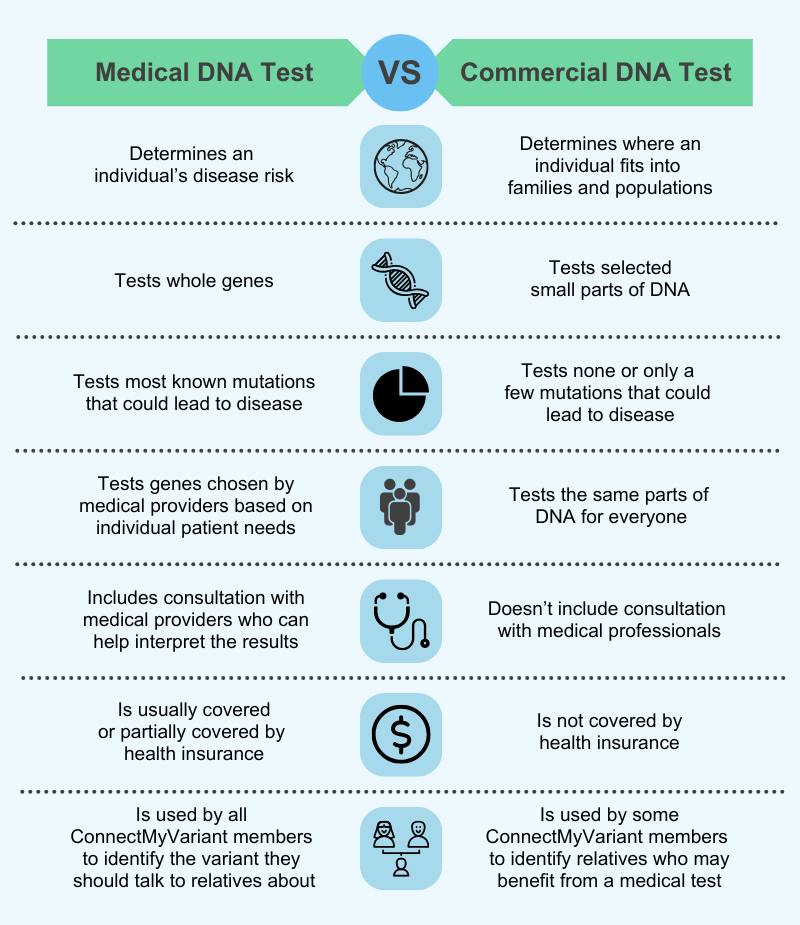
A medical DNA test looks for the first kind of mutations—those that could lead to disease. To do this, the test scans entire genes and reports the order of every building block in sequence. (This is referred to as sequencing.) The goal is to find anything that seems out of place. Not all medical tests read the same genes. A doctor will choose tests depending on a patient’s individual health history and needs. Cancer tests analyze several dozen genes that are known to cause cancer when they don’t work correctly. Cardiomyopathy tests analyze a hundred or so genes that support heart function. The approach of a medical test is: “We think something isn’t working. Let’s scour the genes that could cause this problem to find out
why.”
A commercial DNA test is usually more focused on mutations that don’t affect health, often in the portions of DNA without known functions. Instead of scanning whole genes, it targets certain building blocks. The blocks are located at places where harmless mutations have occurred deep in our ancestral past or many times throughout history. In these spots, building blocks vary from person to person. A commercial test typically looks at 1 or 2 million blocks spread across the DNA, and it looks at the same blocks for everyone. (The test can be called a SNP test. This is an abbreviation for “single nucleotide polymorphism.” A nucleotide is part of a DNA building block, and polymorphism is a term for a variation in DNA.) The approach of a
commercial test is: “There are known variations at these spots. Let’s see which variations you have.”
Medical and commercial tests have different uses.
Because medical tests target genes associated with disease, doctors use them to diagnose, treat or prevent health issues. Everyone in the ConnectMyVariant community joined because of a medical test—either their own or a family member’s. That test found a gene variant with misordered building blocks.
If you think you may have heritable disease in your family, choose a medical test, not a commercial test. You can get the test from a health care provider such as a primary care doctor, a specialist or a genetic counselor.
Commercial tests, on the other hand, are good at identifying where a person fits in world populations. This is because the variations they target are often associated with certain geographical areas. For example, if a harmless mutation first occurred in a person who lived in the Middle East two thousand years ago, that person would pass it on to descendants—who likely stayed in the Middle East. Now, after generations of passing on the variant, many people in that region would have it. If a commercial test finds that you share the variant, too, you probably inherited it through an ancestor who was born there.
Commercial tests are also good at identifying relatives. You inherited a mix of DNA variations from your parents, who each inherited a mix from theirs, and so on. The variations have been mixed and matched for generations, so every set is unique. But the mutations aren’t evenly distributed across the world. You inherited your variations from a small pool of possibilities—the ones your parents had. Your siblings inherited from the same small pool, so you are likely to share several of the same variations with them. A commercial test compares your set of variations to other people’s sets. The more variations you have in common with someone, the more closely you are related to them.
Some ConnectMyVariant members choose to take commercial DNA tests so they can find relatives and build their family trees. Since people get their harmless mutations along the same family lines as their harmful mutations, a pedigree intended to track harmless variations will also track dangerous variants. A commercial test that shows that two people are related does not prove they have the same disease risk. However, it can place someone in a family with a dangerous variant. An individual in that family would need a medical test to know whether they had it for sure.
If you’d like to learn how to use commercial test results to identify relatives with disease risk, you can read about the process here. ConnectMyVariant also occasionally holds free online workshops about using commercial test results. If you’re interested in receiving notice when the next workshop is scheduled, contact info@connectmyvariant.org.
|