C.M.V.: How did interactions in your family change—or did they change—as you went from something being hidden to talking openly about it?
S.L.: My sister and I talked about trying to find a gene so that we could make sure that our grandchildren were safe and that our children were safe. She kept sending her blood to my physician, Dr. McNally, who would send it out to be tested where there were more and more genes being discovered. But it wasn’t one that was discovered.
Dr. McNally said, Look, we don’t know the gene. But we know it’s genetic. And the genes we know are all dominant. So I had a 50% chance (assuming my sister didn’t have a brand new mutation) of having the gene. Each of my children had a 25% chance of having the gene. She recommended that we get echocardiograms, so we would catch something before it got bad. That’s what the recommendation was at the time. I wanted to alert my children to this, and my husband didn’t want me to. He thought, They won’t get married. They won’t have children. Why ruin their life with this fear? I couldn’t live with the idea that they could die because we didn’t tell them. So we came to a compromise. I could tell them anything truthful that
I wanted within that week, but I couldn't remind them every year. They were adults—they should have been able to follow through—so I decided that was a fair enough compromise.
My daughter kept getting tested. Just like me, every time she had a flutter she was worried. When we finally found the mutation, I won the lottery. I didn’t have it. So I called to tell my daughter, and she was so relieved. I called my son, and he said, Was I supposed to be being tested? I told my doctor that I should get tested. And she said, “Does your mother have dilated cardiomyopathy?” I said, “No.” And she said, “Well, you can’t get it.” The doctor had no idea about penetrance. This is not uncommon. I was teaching genetics then, and I made a big point of teaching penetrance to these undergrads to make sure that they got how dangerous it can be for a physician to not realize that if you don’t present with a disease,
you could have a pathogenic mutation and pass it on to your child.
C.M.V.: Why did you choose to write a book about the heart disease risk in your family?
S.L.: We can ameliorate risk, we can save lives, we can improve lives, if people get tested. But what I’ve learned is, not only are patients unaware of this, but many physicians are unaware of it. The other problem is that there’s many people who are afraid. They think it’s going to change their life for the worse, and somehow, if they just don’t know, it’ll go away. The idea that they might have to get a heart exam a couple of times a year—that’s going to be very disruptive to their life.
When you’re living it, it’s not so bad. You’re alive. So you have a defibrillator in your body. So it may go off on occasion. But you still can marry, you can still have children. You can live!
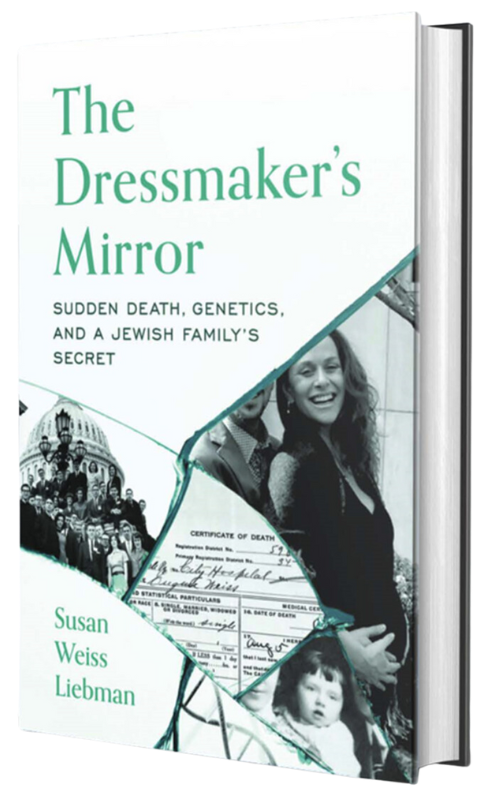
What I wanted to show was a family—and I was lucky enough to have a family full of love and life—and how tragic it was to have a loss, and how we would do anything, any defibrillator, five tests a year, whatever. And without knowing the family, it’s hard to communicate that. I thought by telling our story, people might relate to the need for testing. It really isn’t that expensive any more, and genetic counselors are there to help your physician.
C.M.V.: In your book, you’ve done some nice things to help people who resonate with your story take practical steps in their own life, including appendices where you have a sample letter and some more information. What impact do you hope your book will have on readers?
S.L.: I favor screening. It’s not recommended yet, although they are still considering it. I hope that readers will get screened, readers who can afford 250 to 300 dollars. And I hope that it will help influence the makers and shakers who are going to decide whether we should have screening and pay for it for everybody.
I hope that my book will tell people not to get hysterical if they find something. If you have high cholesterol, you don’t think your life is over—you change your diet. And that’s what I hope that people will respond to if they find something concerning.
C.M.V.: Is there anything that we haven’t talked about that you want to add?
S.L.: A lot of the impetus for writing the book was also a love story to my family. They dealt with this problem and dealt with life in a way that I am proud of. I benefited greatly from them and I miss them. It was a fun thing to try to bring them to life and bring their story to life.
|