Share
What is a risk penetrance estimate? Find out more about participating in studies.‌
 ‌ ‌ ‌ ‌ ‌ ‌ ‌ ‌ ‌ ‌ ‌ ‌ ‌ ‌ ‌ ‌ ‌ ‌ ‌ ‌ ‌ ‌ ‌ ‌ ‌ ‌ ‌ ‌ ‌ ‌ ‌ ‌ ‌ ‌ ‌ ‌ ‌ ‌ ‌ ‌ ‌ ‌ ‌ ‌ ‌ ‌ ‌ ‌ ‌ ‌ ‌ ‌ ‌ ‌ ‌ ‌ ‌ ‌ ‌ ‌ ‌ ‌ ‌ ‌ ‌ ‌ ‌ ‌ ‌ ‌ ‌ ‌ ‌ ‌ ‌ ‌ ‌ ‌ ‌ ‌ ‌ ‌ ‌ ‌ ‌ ‌ ‌ ‌ ‌ ‌ ‌ ‌ ‌ ‌ ‌ ‌ ‌ ‌ ‌ ‌ ‌ ‌ ‌ ‌ ‌ ‌ ‌ ‌ ‌ ‌ ‌ ‌ ‌ ‌ ‌ ‌ ‌ ‌ ‌ ‌ ‌ ‌ ‌ ‌ ‌ ‌

February 2025
Issue #40

Why Disease Risk is Given as a Range–And How to Feel More Confident in Your Preventative Choices Anyway


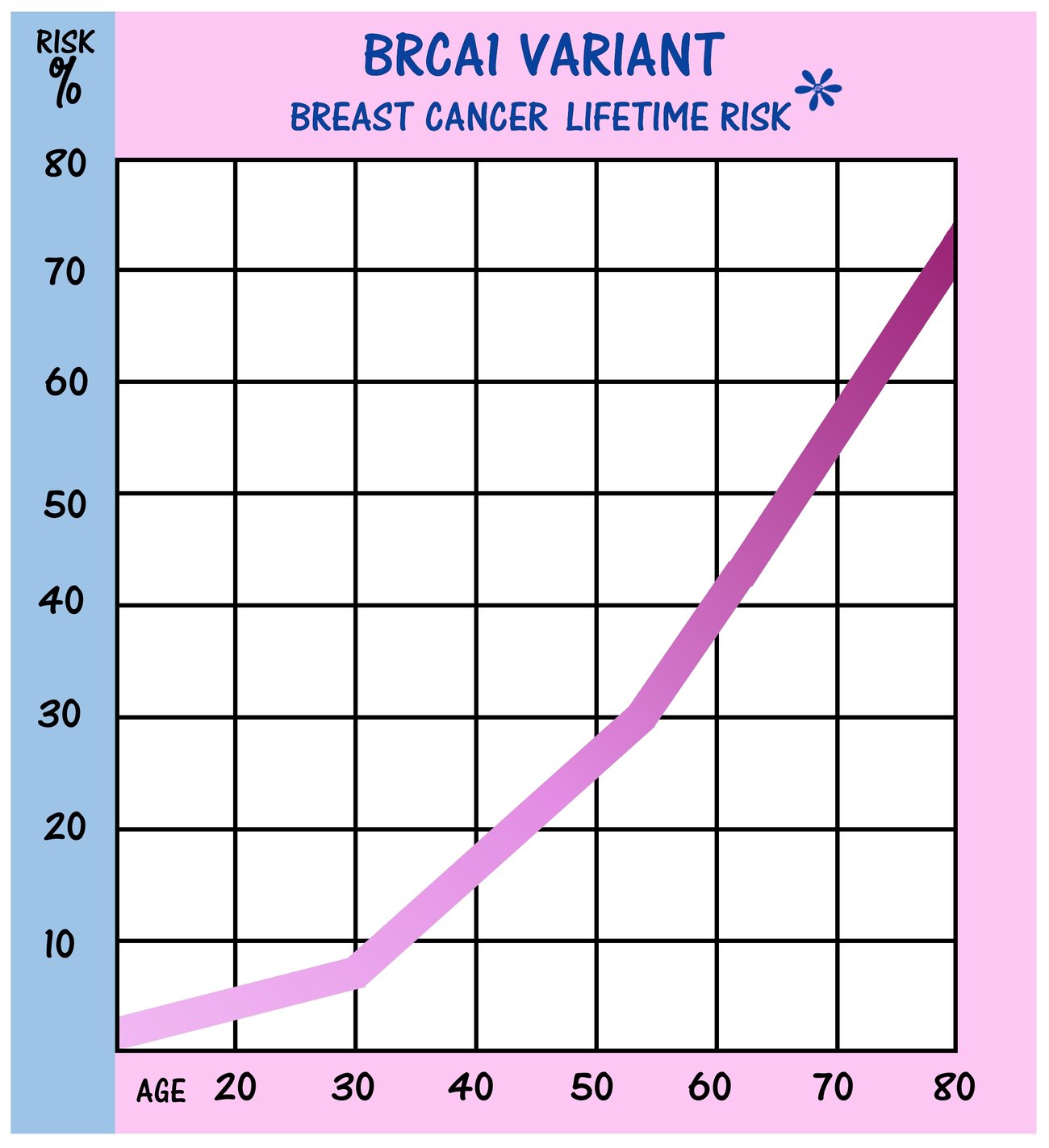
When a person is diagnosed with a pathogenic variant associated with cancer or heart disease, their risk of getting disease is often given as a range of percentages. For example, a woman diagnosed with a pathogenic variant of BRCA1 may be told that her risk of getting breast cancer by age 80 is around 54–72%. That range, called the gene’s risk penetrance estimate, can guide decisions about preventative care. But for many people, the range feels uncertain and frustrating. You may lean toward one choice about an invasive surgery if your chances are on the low end but a different choice if they are on the high end. Understanding where these numbers come from can help you make more informed decisions.

Not everyone with a pathogenic variant of a gene gets the disease associated with that gene.

People inherit two copies of a gene, one from each biological parent. When a person has a pathogenic variant, usually only one copy is affected. Whether or not you develop the disease depends on several factors, including how well the working copy carries the burden for the pathogenic broken copy. (To read more about this, see “Just Enough Genetics To Understand Your Pathogenic Gene Variant.”)


The numbers come from multiple studies.

To determine risk penetrance, researchers study two groups of people: a group with mutations in a certain gene and a group without mutations. They monitor who gets disease and who doesn’t, and they compare the disease rates of the groups. The group with mutations will have more cases of disease—but how many more? That difference in disease rates is the basis for the risk penetrance numbers.


The first studies of a gene often choose group members from families known to have hereditary disease. Since multiple relatives carry the variant, researchers can expect that several people will develop the disease, making the difference in disease rates clear. There are also other advantages to studying these families. If two cousins share the variant, researchers can assume a common grandparent did, too, and fill in the blanks. Studying families with the variant is cost effective and gives a good general picture of the risk.


But these studies have a downside as well—risk for one family may not be the same as risk for unrelated people. Family members might share one or more factors that affect the disease, like diet, lifestyle or other genes. Their variant might be more damaging than other pathogenic variants of the same gene. They might have more disease than average by sheer bad luck.


So after the first studies, more are needed. Another study might work with people from a different part of the world, from a different background or with a different age distribution. And those studies will get different results. They’ll show different risk penetrance.


The choice of who to study matters. But researchers can’t know exactly how. There are too many possibilities—diet, lifestyle, age and other genetic factors. Any individual person might have a higher or lower risk based on these unknown factors. You don’t know which of these factors you might have, so a risk penetrance estimate is given to you as a range. 


Risk penetrance estimates can change.

The longer a gene is known to be associated with disease, the more studies are conducted. The more studies that researchers perform, the more information they have. Risk penetrance estimates are updated to reflect new knowledge.

Different variants of the same gene can have different risk penetrance.

Usually, a risk penetrance estimate is based on only a few variants of a gene. Patients with other variants may notice that the pattern of disease in their own families doesn’t match the official estimate.


Genetic counselor Angela Jacobson’s family history includes people with brain and breast cancers starting at about age 50. Genetic testing shows a mutation in TP53. Mutations in this gene cause Li-Fraumeni syndrome. People with this syndrome can experience multiple cancers across their body, usually starting before age 30. In Angela’s family, the pattern is different.


The first studies on TP53 looked at families with many cases of disease. Inheritance in those families was obvious. However, because of families like Angela’s, the picture of Li-Fraumeni syndrome is changing. Variants with a lower risk penetrance are being identified. Her relatives are now taking part in a study of TP53 variants.


Angela said her family’s genetic counselor gave good advice: “Don’t Google Li-Fraumeni because your family is different.” The counselor told the family exactly what they should get screened for and provided documentation of what was known and unknown.


Resources are available to help you make decisions when numbers are uncertain.

Risk penetrance estimates give a range wide enough to describe many people in many situations. You may feel overwhelmed trying to apply these general estimates to your unique situation. You don’t have to make health care choices alone. Resources are available to help.


Recommendations and guidelines


For genes known to have associated cancer risks, the National Comprehensive Cancer Network recommends prevention steps. The most extreme precautions are reserved for mutations with high risk penetrance estimates.


“It’s not only important for us to know that this gene has been proven over and over again that it causes cancer risk, but we also need to know that it’s high enough that the surgical prevention would be beneficial,” said certified genetic counselor Jessica Corredor. “If we see a gene that’s putting people at a 50 or higher percent risk for breast cancer, that’s when surgical prevention potentially starts being discussed.”


The American Heart Association Task Force on Clinical Practice has released guidelines that include prevention steps for hereditary hypercholesterolemia.


Genetic counselors


The guidelines for your gene might feel too extreme—or too conservative. Your gene may not have set guidelines. In these cases, a genetic counselor can talk you through a decision about treatment for cancer or heart disease.


“Is your worst-case scenario that you do have surgery that you never needed to have?” Jessica asks. “Or is your worst-case scenario that you didn’t get the surgery and you do develop a cancer, and you look back wishing you had done the surgery?”


Since genetic counselors typically spend more time with patients than doctors do, they can help those patients make decisions on their terms and at their own pace.


“If they need time to think through their decisions, to see what they feel comfortable with, in the meantime we can absolutely still screen them and give them the reassurance every few months that things are looking okay,” Jessica said.


Genetic counselors can also advise you on complicated prevention and screening situations.


“If cancer is found early,” Angela said of the brain cancer in her family, “it’s possible that the surgery to remove the tumor could cause more disability than the tumor would. Counselors can help you think about whether some screenings can improve quality of life. Is screening really helping prevent disability and morbidity or not?”


High-risk centers


Many hospitals in metropolitan areas have high-risk cancer centers that specialize in hereditary cancer treatment and prevention. A few hospitals have high-risk heart disease centers with similar services. High-risk centers are more likely to have up-to-date information than primary care providers. They can navigate the changing knowledge about genes and the unique challenges posed by individual variants. This is especially true for lesser-known genes. These centers also offer coordinated screenings, prevention and treatment. This level of coordination can help mitigate and balance the risks of treatment.


Genetics teleservices


For some patients, travel to a high-risk cancer center is not possible. Fortunately, access to medical professionals through teleservices is increasing.


“There’s some fantastic cancer genetics professionals that are available through teleservices, and I would highly recommend them as a starting place,” Angela said.


Get Involved in Risk Penetrance Research

ConnectMyVariant is currently applying for a grant to develop ways to calculate cancer risk for individual variants. Watch your email in the coming days for more information about how your donation can help secure this grant, or learn more now at this link.

At the same time, ConnectMyVariant is teaming up with researchers who study variants that might have different disease risk penetrance than other variants of the same gene. Do you know someone with one of the variants listed below who might be interested in being part of a study on their variant’s risk penetrance? Invite them to sign up for or contact ConnectMyVariant.


ATM

c.-30-1G>T  ;  c.1234T>C, p.Trp412Arg  ;  c.3154-1G>A  ;  c.5007-3T>A  ;  c.5763-1056G>A  ;  c.5674-1G>A  ;  c.6154G>A, p.Glu2052Lys  ;  c.6200C>A, p.Ala2067Asp  ;  c.6919C>T  ;  c.7629+2T>C  ;  c.8787-13G>T

BARD1

c.159-1G>T  ;  c.1596-12T>G

BRCA1

1406insA*, c.1287dup  ;  185delAG  ;  c.213-11T>G; 2800delA*  ;  5382insC*, c.5266dup  ;  c.4185+1insAdel21  ;  c.4986+3G>C  ;  c.4485-1G>A  ;  c.4987-4T>G  ;  c.5022C>T, p.I1674I  ;  c.5096G>A, p.R1699Q  ;  c.5277+1G>A  ;  c.5406+4delAGTA  ;  c.5407-25T>A  ;  c.594-2A>C  ;  c.594-12G>A  ;  c.671-1delins6  ;  c.671-1G>A  ;  c.671-1G>C  ;  c.671-1G>T  ;  c.671-2A>G  ;  c.671-2A>T  ;  c.134(+3)A>C  ;  c.212+1G>A  ;  c.5558insA, p.Y1853X  ;  c.181T>G, Cys61Gly  ;  del exon 17  ;  del exons 14-20  ; dup exon 13

BRCA2

1529delAAAG*  ; 6174delT* c.5496del  ;  6872del4*  ;  7846(-1)G>A*, c.7618-1G>A  ;  7986G>A, p.2586X, c.7758G>A  ;  8475delGA*  ;  c.229A>G, p.Thr77Ala  ;  c.658_659del  ;  c.7007G>A, p.Arg2336His  ;  c.7007G>C, p.R2336P  ;  c.7007+1G>C  ;  c.7007+5G>A  ;  c.7522G>A  ;  c.7976G>A, p.R2659K  ;  c.7976+2C>G  ;  c.7878G>C  ;  c.7878G>T  ;  c.8331+3A>C  ;  c.8488-1G>A  ;  c.8488-1G>T ;  c.9104A>C  ;  c.9302T>G  ;  c.9672dup  ;  c.9699_9702del  ;  c.5350_5351del

BRIP1

c.93+1G>A

CHEK2

c.320-5T>A  ;  c.592+3A>T  ;  c.592+4A>G, chr22:29,120,961T>C  ;  c.846+4delAGTA

CDH1

c.1565+1G>A

PALB2

C.172_175del  ;  c.3113G>A, p.W1038X  ;  c.3116del  ;  c.3549C>G  ;  c.509_510del  ;  c.757_758del

RAD51C

c.904+5G>T  ;  c.1026+5delGTA

TP53

c.473G>A p.R158H  ;  c.541C>T p.R181C  ;  c.542G>A p.R181H  ;  c.854G>A p.R282Q  ;   c.847C>T p.R283C  ;  c.1010G>A p.R337H

Illustration by Mark Hicks

Donate

ConnectMyVariant is a 501(c)(3) nonprofit.
Your tax-deductible donation helps families prevent hereditary disease.

Visit our donation page at Every.org to give.

ConnectMyVariant's Mission: 

To end hereditary disease by bringing families together.
Donate Now


Email Marketing by ActiveCampaign