|
My story begins the day my oldest sister was diagnosed with triple-negative breast cancer at the age of 33. The news devastated my family and shook us to the core. We had never imagined that cancer would touch our family. Due to my sister’s young age and the aggressive nature of her cancer, her doctor recommended genetic testing. The test confirmed that my sister carried the BRCA1 gene mutation. Her genetic counselor advised that immediate family members should also undergo testing.
It was an easy decision for me to pursue testing. The day I received my positive BRCA1 result, I was caught in a whirlwind of emotions. My initial reaction was a mixture of confusion, shock and uncertainty. So many questions crossed my mind. What would my future look like now, knowing I carry a harmful and potentially life-threatening mutation? I was determined to learn as much as possible and do everything I could to reduce my risk of cancer.
I met with a genetic counselor, who provided valuable education on preventive measures and resources to support women living with hereditary gene variants. I left that appointment feeling empowered, informed and ready to tackle this newfound knowledge head-on.
I joined a BRCA gene mutation support group on Facebook and discovered a community of women courageously sharing their stories. It brought comfort knowing I was not alone. Within the group, I came across a post written by Dr. Brian Shirts about ConnectMyVariant, which was then a research project that helped individuals with hereditary variants locate relatives who may carry the same mutation. I was intrigued by the opportunity and motivated to locate distant relatives who may be unaware of the gene mutation.
I joined Ancestry and immersed myself in genealogy. I studied my family roots intensely and began making connections. I paid close attention to female relatives who had passed away at young ages. These pieces of family history became clues, guiding my search as I reached out to possible relatives and shared my story. I explained my family history and the discovery of my BRCA1 mutation.
At the time, I didn’t know whether my efforts would lead to anything meaningful. The individuals I contacted responded kindly and thanked me for the information. There were also messages that went unanswered. But after several months without clear answers, I began to feel discouraged. I decided to take a break from Ancestry and ConnectMyVariant. I felt defeated that I hadn’t located anyone who shared my mutation.
A year later, I received a message on Ancestry from someone I had previously contacted. She had passed along my contact information to her aunt Sara, who wanted to connect with me.
Sara and I began exchanging emails and sharing details about our family histories. As we pieced together our connection, we discovered that we were related; my great-grandfather and Sara’s grandmother were siblings. As we talked more, a troubling pattern emerged. Sara’s grandmother had passed away from breast cancer at 51. Her mother had died from ovarian cancer at 67.
When Sara learned about the BRCA1 mutation in our family, she made the decision to undergo genetic testing. The results confirmed that she carried the same mutation. Having this knowledge, Sara chose to be proactive. At age 58, she pursued preventive surgery: a salpingo-oophorectomy (removal of ovaries and fallopian tubes) to significantly reduce her ovarian cancer risk.
As part of the routine procedure for risk-reducing surgery, her doctors sent the tissue for biopsy. The pathology results revealed something none of us expected; Sara had already developed primary fallopian tube cancer, which was categorized clinically under ovarian cancer. (Emerging research suggests many ovarian cancers originate in the fallopian tubes before spreading.)
Because she underwent surgery before symptoms developed, the cancer was caught at an early stage. Treatment was initiated promptly and was successful. Today, I am grateful to share that Sara is cancer-free and living a healthy life. She has alerted other relatives about our variant.
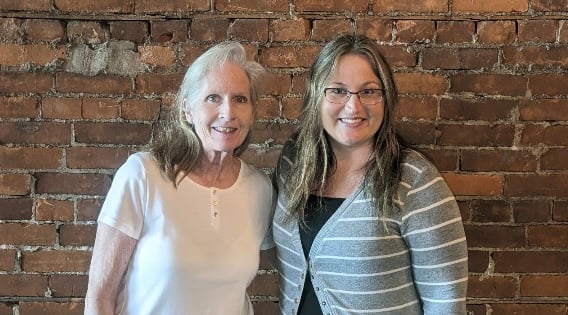
In 2023, I underwent a preventive double mastectomy with reconstruction to significantly reduce my own cancer risk. That same year, Sara and I met in person for the first time when she traveled to attend a funeral in Wisconsin, where I live. We shared brunch, stories and future plans. It was such a pleasure to finally meet her and exchange stories.
What began as a determined search through family records became something far greater. It became a moment where knowledge changed the course of someone’s life. Cancer no longer had the upper hand; knowledge did. And together, we realized that by sharing our story, we could help other families recognize patterns, pursue testing and potentially save lives.
While continuing to research my variant, I came across a publication about BRCA1 mutations in Norway. The article was written by a genetic counselor and researcher at Oslo University Hospital who specializes in hereditary cancer. She discovered that my variant occurs in a long valley in Norway called Gudbrandsdalen. My great-great-grandfather emigrated from this valley to Wisconsin in 1871, so he or his wife likely brought the variant with them.
The couple had nine children who survived to adulthood; two of these were my great-grandfather and Sara’s grandmother. Any of the other seven could have inherited the variant, too. Their descendants might be beginning to recognize the same patterns of cancer in their families that Sara and I saw in ours.
I am so grateful that I was able to connect with Sara. I feel less alone in this journey now, and I hope our story inspires others.
|