|
|
 |
New Research Will Improve Risk Estimates For Variants—And You Can Help |
Having a pathogenic variant of a gene can raise your risk for disease—by a lot or a little, depending on the gene and the variant. However, your treatment and prevention options are typically based on the gene, no matter which variant you have. Although variants of the same gene have differences, there’s just not enough evidence to show what those differences actually mean for patients. New research is beginning to fill this gap, and ConnectMyVariant members can play a role.
With a generous grant from the Andy Hill CARE Fund, ConnectMyVariant will work with teams from Vanderbilt University and the University of Washington to study risk for individual variants. Many ConnectMyVariant members want to understand the exact risk of their variants, and we have an eye on expanding research to help as many families as possible. For now, our first project will focus on 45 variants of BRCA1 and BRCA2. People with these variants can volunteer to participate and help scientists gain insight into cancer risk.
|
|
|
Some gene mutations are less damaging than others. |
|
|
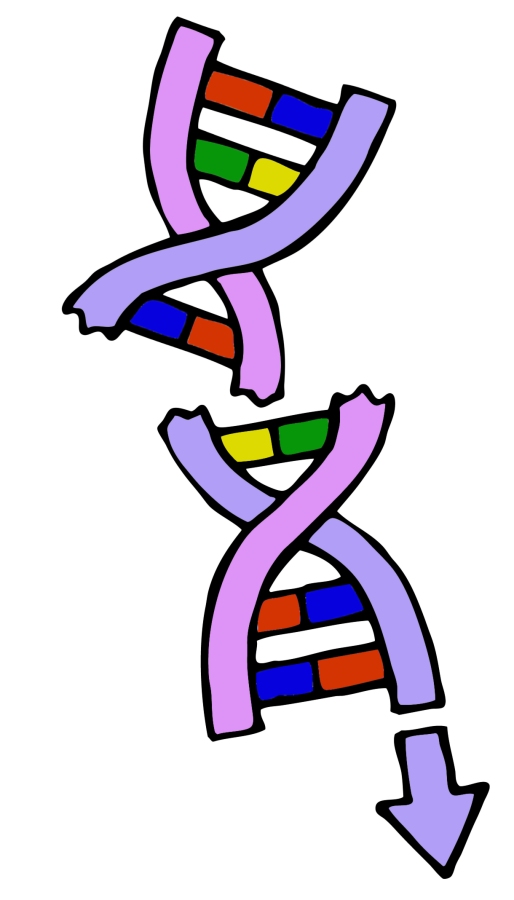
Mutations can damage DNA, creating a broken version of a gene. That gene has a job to do in the body, but the impaired variant of the gene can’t do its job correctly. Its mistakes may lead to disease. Many kinds of mutations can happen. Not all mutations
hurt the gene in the same way.
Some mutations create a variant of the gene that doesn’t work at all. These nonfunctioning copies of a gene are the most common variants in inherited cancers and heart disease. The risk of disease can be very high for people with these variants.
But minor mutations do occur. For example, mutations could change small pieces of DNA. People who carry variants with these mutations may have intermediate risk—higher than the average person but lower than someone with a more destructive variant of the same gene. These variants are called “reduced penetrance variants.” Their penetrance, a way to describe the impact of a mutation, is reduced compared to other disease-causing variants.
|
|
|
What do we know about reduced penetrance variants? What are we still learning? |
|
|
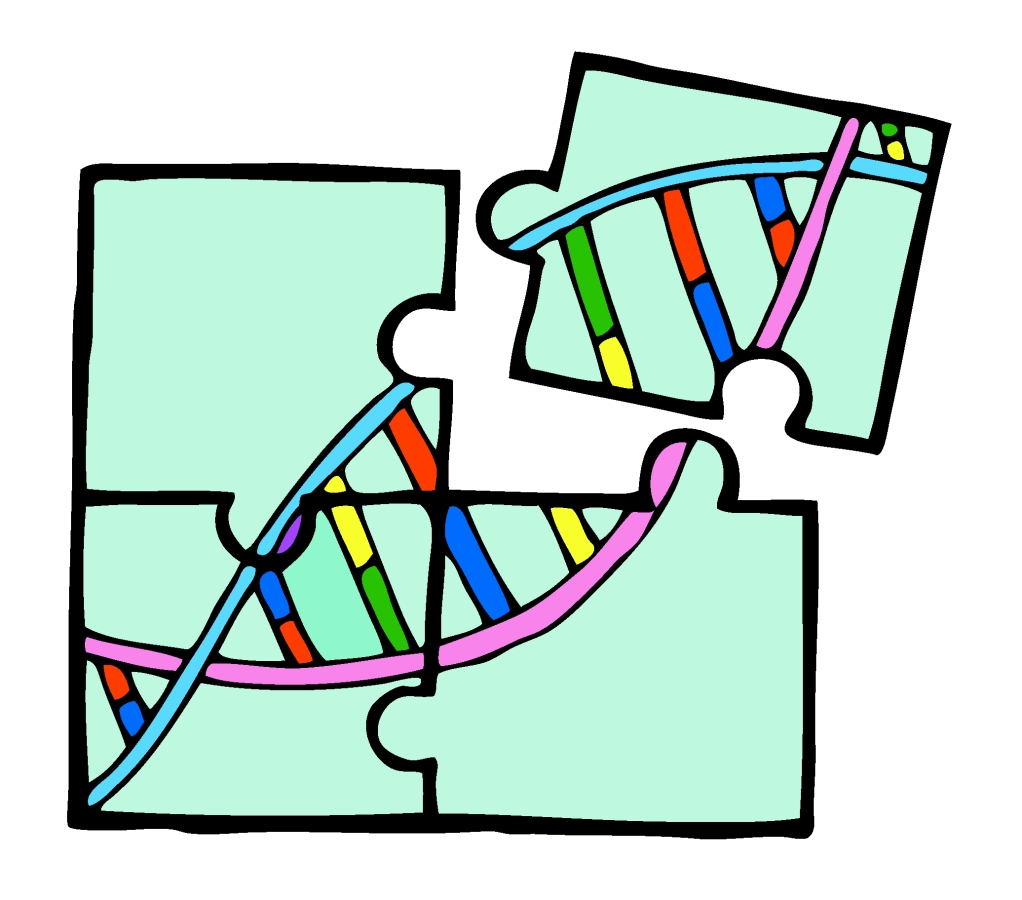
Much of the work on reduced penetrance variants has focused on how damaged genes affect cells in laboratories. Through these efforts, researchers have identified dozens of variants that may fall into this category.
“Once you identify them,” said Dr. Tuya Pal, a clinical geneticist at Vanderbilt University, “there’s still a jump from identifying to clinical management. And that’s a jump we need to make.”
One clinical question is whether reduced penetrance variants respond uniquely to treatment.
“In BRCA1 and BRCA2, we have targeted treatments through the PARP inhibitors,” Pal said. “With these reduced penetrance pathogenic variants, do they respond differently to targeted treatments? We don’t know right now.”
Another research focus is the lifetime risk for disease. The breast cancer lifetime risk of a mutated BRCA1 gene can be as high as 72% (that is, up to 72% of women with a mutation will develop breast cancer by age 80). Faced with these odds, many people choose preventative surgery. But if lifetime risk for a reduced penetrance variant of BRCA1 is lower than 40%, frequent screening may be a better prevention choice than surgery. Accurate risk information can increase patients’ confidence in their medical decisions.
Unfortunately, lifetime risk for these variants is difficult to determine. Researchers usually estimate risk from gene mutations by comparing two groups—one group with inherited mutations and one without. They watch the groups. Who develops the disease? Who doesn’t? The researchers calculate the percentage of people who develop disease in each group. Those percentages become the odds of disease that doctors use to advise patients.
However, most reduced penetrance variants present a challenge for making this kind of comparison: they are rare. Only a few people have a variant, and only some of those develop disease. Even in large studies, the group without the variant may include hundreds or thousands of people, while the group with the variant may have only one or two—not enough to make a comparison that anyone feels confident about. If that one person develops disease, lifetime risk could be calculated higher than it actually is. But if that one person doesn’t develop disease, risk could be calculated far too low. A variant with reduced risk could inadvertently be classified as high risk, or vice versa.
“You don’t want to get it wrong,” Pal said. An inaccurate risk calculation could affect a patient’s choices and, therefore, their outcome. “As much data as we can get … to confirm that these are reduced penetrance is really, really important.”
|
|
|
The ConnectMyVariant community can help fill this gap in knowledge. |
|
|
In most studies, a reduced penetrance variant is too rare to calculate its lifetime risk. However, the variant is not rare in one situation—when a family passes on the mutation. Affected families typically have several members with the variant. These
families provide researchers with the best opportunity to find people who are at risk and track their outcomes. The more people with the variant, the easier it is to see how often the variant actually leads to disease.
This means that you, in building your family tree, have not just created a personal support system—you’ve collected key information to understand your variant. You’ve identified who inherited the variant and did not. You’ve identified who developed disease and who did not. This is the exact data that researchers need to calculate disease risk. Your genealogy work can refine and confirm the penetrance of your variant.
With findings from family trees like yours, genetic test results will have more precision. Health care providers will give their patients more informed guidance. Family conversations will be more accurate.
Shifting focus to individual variants could transform patient experiences.
“We’re really functioning on gene-specific risks rather than variant-specific risks,” Pal said. “But I think that is where the field, hopefully, will eventually move to.”
|
|
|
You can participate in research advancements. |
|
|
The current study focuses on the BRCA1 and BRCA2 variants listed below, which researchers think might have reduced penetrance. If you are a ConnectMyVariant member with one of these variants, we will contact you to ask if you’d like to
participate. ConnectMyVariant will not automatically enroll members without their knowledge and consent.
If you know someone who has any of these variants and is not a ConnectMyVariant member—from your family, social media groups or other circles—ask them if they would like to participate.
Your volunteer service will help confirm whether your variant has reduced penetrance and calculate what its lifetime risk is. Participants will work with genetic counselors to map their family trees and identify the instances of cancer. They will receive extra family history assistance as part of the study. In certain cases, eligible family members may receive AncestryDNA kits or genetic testing free of charge.
Anyone interested in volunteering or learning more about this project can contact Research Coordinator Kathryn Mraz at kathryn@connectmyvariant.org.
|
|
|
Variants in the Current Study
| BRCA1 | BRCA2 |
|---|
c.134+2T>A
c.212G>C
c.302-2A>C
c.316+5G>A
c.441+1G>A
c.441+2T>A
c.4868C>G
c.4987-4T>G
c.4987-1352A>G
c.5056C>T, p.H1686D
c.5095C>T, p.R1699W
c.5096G>A, p.R1699Q
c.5107T>G, p.Y1703D
c.5117G>A, p.G1706E
c.5123C>A, p.A1708E
c.5152+1G>C
c.5194-12G>A
c.5278-1G>A
c.5363G>T, p.G1788V
c.5407-25T>A
c.78_79ins6, p.26_27insHL
|
c.316+1G>A
c.475+4delT
c.7766C>A, p.P2589H
c.7820C>T, p.T2607I
c.7878G>C, p.W2628C
c.7879A>T
c.7958T>C, p.L2653P
c.7976G>A
c.7982A>T, p.D2661V
c.7988A>T
c.7992T>A
c.8162T>A, p.L2721H
c.8167G>C, p.D2723H
c.8168A>G
c.8331+2T>C
c.8332-9T>G
c.8393C>G, p.P2798R
c.8444C>A
c.8471G>A, p.R2824K
c.8632+1G>A
c.8754+4A>G
c.8864-21del26
c.9501+3A>T
c.8487+3A>G
|
|
Illustrations by Mark A. Hicks
|
|
|
Job Opening: Operations and Administrative Manager |
ConnectMyVariant will be opening a position for an Operations and Administrative Manager. The position will be full time and fully remote. We are seeking motivated individuals with exceptional organization skills and a deep understanding of hereditary disease prevention. The complete job description and position announcement will be available in the next few weeks. If you’d like to receive notice when the job description is published, let us know at work@connectmyvariant.org.
|
|
|
|
|
RootsTech Registration is Open |
RootsTech, a popular genealogy conference, will take place in Salt Lake City, Utah, on March 5-7, 2026. Sessions offer information and support for family history researchers of all skill levels. Registration for the online portion of the conference is free. If you’re interested in learning more about genealogy research, you can register for the virtual conference here.
|
|
|
 |
ConnectMyVariant is a 501(c)(3) nonprofit.
Your tax-deductible donation helps families prevent hereditary disease.
Visit our donation page at Every.org to give.
|
| Donate Now
|
|
|
|
|